
Intimate lightening, also called intimate bleaching, is a professional treatment that softens darker pigment in sensitive areas such as the bikini line, inner thighs, underarms, and genital area. At BioSpa®, we use Dermamelan® Intimate, a medical-grade depigmenting method that pairs a single in-office application with a guided at-home routine. Your treatment is performed by our expert team and overseen by board-certified plastic surgeons, so you can feel confident about both your comfort and your results.
If you have been quietly researching intimate bleaching for a while, here's what we want you to know first: you are not alone, and there is nothing wrong with your skin. Darker pigment in intimate areas is normal, common, and healthy. Many patients prefer a more uniform tone, and that is entirely your choice to make.
At BioSpa® in Newport Beach, patients from across Orange County come to us for this treatment because of how we approach it, with privacy, real education, and medical oversight at every step. Your consultation is always free, and it is a conversation, never a sales pitch.
What Is Intimate Lightening?
Melanin is the natural pigment that gives your skin its color, and it is not spread evenly across your body. Intimate lightening works by gently reducing melanin in delicate areas, so your skin tone looks more consistent from one area to the next. The goal is not to change who you are. The goal is to soften a contrast in tone that some patients find bothersome. You may also see this treatment called intimate bleaching or genital bleaching, depending on the area you are treating. Both describe the same gentle process of reducing pigment in delicate areas.
At BioSpa®, we perform this treatment using Dermamelan® Intimate, a depigmenting method formulated specifically for delicate skin. It is a topical protocol, not a laser, which makes it a comfortable option for areas where heat-based devices can feel intense.
Here's something worth knowing: licensed practices are the only outlets that can sell professional-grade depigmenting products, and that restriction exists for good reason. The FDA has repeatedly warned consumers about over-the-counter skin lightening products containing mercury or hydroquinone, noting there are no FDA-approved or legally marketed OTC skin lightening products, and that repeated use can lead to kidney damage, nerve damage, or permanent skin discoloration. Please do not treat this area at home with something ordered online.
What Causes Skin to Darken in Intimate Areas?
Melanin naturally concentrates more heavily in some areas of the body than others. On top of that, several everyday factors can deepen tone over time:
- Hormonal shifts during puberty, pregnancy, or menopause
- Friction from tight clothing, exercise, or grooming habits like waxing and shaving
- Genetics and your natural skin tone
- Natural aging and changes in skin quality
None of this reflects poor hygiene or poor health. It is ordinary biology, and it happens to men and women alike.
There is one clinical detail worth knowing before you treat anything cosmetically. Not every dark area is simple pigment. A review of pigmented vulvar lesions found that these are seen in roughly 8-12% of women and are frequently overlooked. This is exactly why we evaluate the area in person first, and why we will refer you for a medical opinion if anything looks like it needs one before we proceed.
How Does Dermamelan® Intimate Work?
Dermamelan® Intimate works in two ways at once. First, it helps your skin gently renew itself so pigment that has already built up starts to fade. Second, it calms the pigment-producing cells in your skin so new dark spots are less likely to form. This dual-action mechanism is what sets it apart from treatments that only fade existing pigment without addressing why it comes back.
The formula uses ingredients with a strong research track record, not harsh chemicals. Niacinamide helps slow down how pigment moves to the surface of your skin: one clinical study reduced pigment transfer by 35-68% and visibly reduced dark spots after just four weeks of use. Kojic acid works by blocking the pigment-producing enzyme in skin, and azelaic acid is an established depigmenting ingredient in its own right.
We also want to be honest about the evidence here. A small pilot study of the facial version of this formula found that ten women with melasma saw about 50% improvement, with only mild irritation reported. That study was done on the face, not the intimate area, and ten patients is a small group to draw conclusions from. We would rather tell you that than oversell it.

What Happens During Treatment?
Your treatment happens in two phases, and the second one is genuinely the one that determines your outcome.

Afterward, expect the area to feel warm, look pink, and go through some light flaking. This warm, red sensation is mild and expected, and it typically settles within 24-48 hours, with minor peeling normal during the at-home stage. Because the treatment is topical, you can return to daily life right away.
Most patients notice initial brightening within the first couple of weeks, with continued improvement over roughly two to three months of consistent home care.
One honest note about longevity: areas prone to pigment will always keep some tendency toward it, which is why sun protection and your home routine matter long term.
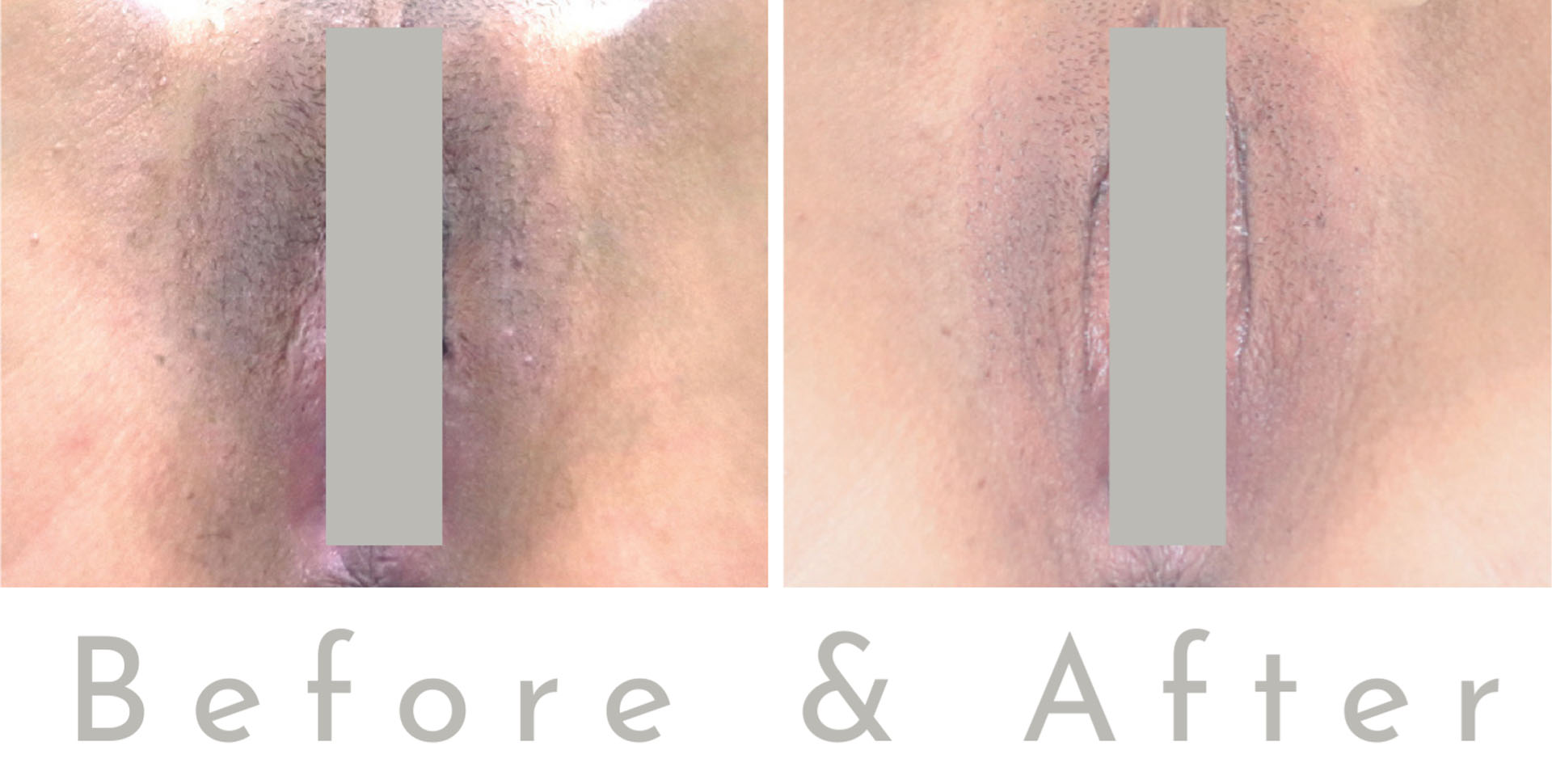
Which Areas Can You Treat?

Both men and women choose this treatment. We most often address the genital area, groin, inner thighs, and perianal area, and we can also treat the underarms and nipples. If you have pigment concerns elsewhere, such as the neck, chest, back, or knees, we are happy to talk through our other hyperpigmentation treatments with you.
Am I a Good Candidate for Intimate Lightening?
You may be a strong candidate if you are in good general health, you have uneven tone in an intimate area that bothers you, and you are realistic about a treatment that unfolds over weeks rather than overnight. This method suits a wide range of skin tones and skin types, which is one of its real advantages.
You should postpone treatment if you are pregnant or breastfeeding, or if you have an active viral, fungal, or bacterial infection in the area. We will also pause and reassess if we see any pigmented spot that warrants a medical evaluation first.
You are also not a good candidate if someone else is pushing you toward this. This is an elective, personal choice. If you come in and decide it is not for you, that is a completely acceptable outcome, and no one here will make you feel otherwise.

What Other Treatments Pair Well With Intimate Lightening?
Intimate lighting often pairs well with other treatments, depending on your goals. Many patients combine it with non-surgical vaginal rejuvenation, the Bi-O! Shot™, or laser hair removal. We will map out a plan that fits your goals and your budget at your consultation, and affordable financing options are available.

BioSpa® is owned and operated by board-certified plastic surgeons Dr. Jed Horowitz and Dr. Larry Nichter, each with 25+ years of aesthetic experience. Meet our surgeons to learn more about their backgrounds. Their oversight is not a marketing line, it is the operating structure of the practice.
Your treatment itself is performed by our expert team of nurse providers and Medical Aestheticians, specialists who work with pigment every day and who have handled sensitive, personal consultations countless times. Nothing about your visit will feel clinical or cold. We are also a Diamond Level Allergan Provider, among the top aesthetic practices in the United States, and we have been voted Best in Orange County by Modern Luxury Riviera Orange County and Parenting OC.
FAQs
People use the terms interchangeably, but "lightening" is the more accurate word for what happens. We are gradually reducing excess pigment with medical-grade topicals, not applying a household bleaching agent.
Cost depends on the areas treated and whether additional treatments are recommended, so we provide an exact quote at your consultation rather than a number online. Consultations are free, and affordable financing options are available if monthly payments work better for you.
Many patients see a visible difference after one full cycle, the in-office treatment plus the at-home routine. Some patients benefit from additional sessions depending on how much pigment they are treating. Your specialist will recommend a plan for you at your consultation.
Results are long-lasting but not permanent, since skin that is prone to pigment keeps that tendency. Many patients schedule a touch-up treatment every 3 to 6 months to help maintain their results, along with daily sun protection.
Ready to Schedule Your Free Consultation?
You deserve to feel comfortable in your own skin, and you deserve to explore that with people who will treat the conversation with the care it warrants. If you are in Newport Beach or anywhere across Orange County, we would love to meet you.
Schedule your free consultation with BioSpa®, in person or by phone. Consultations are also available in English and Spanish, and we will talk through whether intimate lightening is the right fit for your goals.
Schedule Your Free ConsultationSource Index
- U.S. Food and Drug Administration. "FDA Warns Consumers of Skin Products Containing Mercury and/or Hydroquinone." fda.gov
- Lisner T, Plantier F. "Diagnostic des lésions pigmentées de la vulve." Annales de Pathologie. 2021;42(1):79-84. DOI: 10.1016/j.annpat.2021.01.002
- mesoestetic. "dermamelan® intimate" product line page. mesoestetic-me.com
- Hakozaki T, Minwalla L, Zhuang J, et al. "The effect of niacinamide on reducing cutaneous pigmentation and suppression of melanosome transfer." British Journal of Dermatology. 2002;147(1):20-31. DOI: 10.1046/j.1365-2133.2002.04834.x
- Saeedi M, Eslamifar M, Khezri K. "Kojic acid applications in cosmetic and pharmaceutical preparations." Biomedicine & Pharmacotherapy. 2019;110:582-593. DOI: 10.1016/j.biopha.2018.12.006
- Gunia-Krzyżak A, Popiol J, Marona H. "Melanogenesis Inhibitors: Strategies for Searching for and Evaluation of Active Compounds." Current Medicinal Chemistry. 2016;23(31):3548-3574. DOI: 10.2174/0929867323666160627094938
- Tsilika K, Levy JL, Kang HY, et al. "A pilot study using reflectance confocal microscopy (RCM) in the assessment of a novel formulation for the treatment of melasma." Journal of Drugs in Dermatology. 2011;10(11):1260-1264. PMID: 22052305